Rooting out corporate power to seed a flourishing world
Dear friend,
I put the slim book on the counter and slid the cashier the money I had saved. I had picked out the best-seller L’Horreur Économique (The Economic Horror) by Viviane Forrester from among the stacks of new books because I wanted to practice my French. But as I dove into Forrester’s impassioned prose, improving my French became secondary to exploring the world the book opened for me—a reality that I had sensed but hadn’t yet found words for.
I was a teenager on the outskirts of Mexico City in a poor neighborhood where lives could change in an instant. We moved frequently when the rent increased or informal arrangements fell apart. We contended with inconsistent basic services—running water, for example, was available only a few hours a day, a few days a week. When it didn’t come, we walked to a well miles away to bring water home.
Stability wasn’t something we assumed; it depended on what held that month. I sensed that our neighbors’ lives were disposable; our futures not guaranteed. But I couldn’t say why. Forrester’s book gave me the language to name that unease. I began to see the forces that shaped my life: corporate power and—a new word for me at the time—neoliberalism. This, as Forrester explained, was a project to undermine the role of government and eliminate any support for the public good in order to let the market run free.
I stepped through the door that Forrester’s book opened, and I’ve never looked back.
Today, as the first Executive Director of color at Corporate Accountability, it informs my conviction that challenging corporate power is inseparable from protecting democracy itself. This is especially true as we witness the crisis of the corporate capture of democratic institutions and decision-making, rising fascism, and the vicious erasure of even the most basic protections for people and the planet. The deep feeling of unease that I had as a child about whether I and my family would survive the conditions we lived under—that feeling remains, and has grown, for so many of us in the U.S. and across the Global South. And so the work of challenging the rotten corporate core of our broken systems feels imperative in this movement.
The horrors of the past year and a half have many folks pinning their hopes on electoral politics as the way out. It’s critical to have public officials in government who will truly work for the people, so I understand how it can feel like the answer. But if politicians who are not bought by corporations are to actually deliver policies that help all people thrive, there needs to be fundamental changes in the system that we all operate within.
Corporate power pushes crises after crises
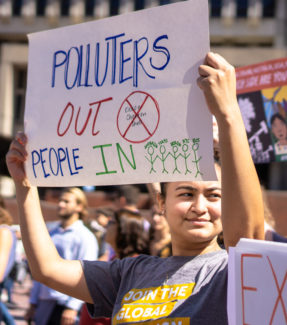
You and I aren’t alone in seeing the harms of corporate power. From #TeslaTakedown to corporate-focused protests against ICE in Minneapolis, people around the U.S. are challenging corporations enabling the Trump regime’s deadly policies. Many see how corporations are propping up and profiting from authoritarianism.
But the current fascist-corporate brand of governance is only the most blatant form of what we’ve been experiencing for more than 50 years. I remember the trickle-down economics of Reagan, the oil-fueled Gulf Wars under both Bush presidents, and Clinton’s disastrous “right to work” policies. The logic of neoliberalism, the drive of the market, and the power of corporations have had the winning hand, including under Obama and Biden. Just look at Biden’s hard-won Infrastructure Investment & Jobs Act, which, in the end, included significant corporate subsidies (with one big exception: thanks to our and our allies campaigning, there were no new handouts to water privatizers).
Over this half a century, corporations have amassed a staggering amount of wealth for their executives and shareholders. In 2024, the revenue of 500 of the world’s largest corporations totaled $41.7 trillion, and the 10 richest U.S. billionaires became $698 billion wealthier last year.
With such wealth, they write the rules. Corporate employees spin through the revolving door into government agencies that are supposed to regulate the very industries they came from. Corporations move jurisdictions into government to avoid accountability. They pour money into elections to influence public officials to do their bidding and buy public goodwill.
They cut down the Amazon; poison communities; profit from war in Palestine, Iran, and the Congo. Our neighbors struggle to make rent, our elders must choose between medicine and meals, and all of our wallets grow thinner as prices keep climbing. This is the violent shaping of whose lives matter and who gets to have a future that Forrester wrote about.
In the most life-threatening issues of our time such as the crisis of democracy, the climate crisis, and the water crisis, we see the common thread running through them all: corporate power. So to truly address the conditions that have paved the way for the Trump regime’s policies and to have the most chance of reviving democracy globally, we must reckon with the heart of the problem.
Moving people can shift systems
I know it can feel impossible. But as Ursula Le Guin said in 2014: “We live in capitalism, its power seems inescapable—but then, so did the divine right of kings. Any human power can be resisted and changed by human beings.”
All our systems are made up of people. And people can change—or be moved to change. How many times have you seen in the news that “the markets” rallied or dipped, as though they’re some mysterious, sentient being that we can’t control or fathom? We’re conditioned to believe the economic system is nameless, faceless, and unchangeable. But it’s not. There are people across the private and government sectors who make decisions every day, giving more or less power to corporations.
Corporate campaigning starts from that reality. We look at the problem and analyze the conditions behind that problem. We research the people in the corporations making decisions that cause the greatest harm. What do they care about? What kind of pressure will move them to make different decisions? How do we make it more costly for them to continue causing harm? From there, we develop strategies and try out tactics. We refine, hone, and try again until we win.
We do this every day, day in and day out. It’s not an every two- or four-year push. We do it for the long haul, with targeted strategies and in collaboration with allies to make powerful shifts in the ways corporations can operate. And eventually, this work of movements can shift an entire economy. It can bring down kings.
Corporate campaigning is democracy in action
What does that look like, exactly? Let’s look at our water campaign. The heart of the campaign is our shared belief that water is a precious, shared resource and access to it is a fundamental human right. Therefore, it should be managed democratically for the good of all and not exploited for profit. As we like to say, this campaign is democracy in action.
We launched the campaign by targeting corporations selling this shared resource to us in bottles. By the early 2000s, these corporations had convinced most people in the U.S. that the best, safest water came from a plastic bottle. The water industry as a whole sought to cast doubt on the safety of public water so that some corporations could swoop in and privatize systems, while others raked in profits from bottled water sales.
We and our allies campaigned to expose the greedy underpinnings of the water industry’s actions. Together, we created a sea change in the public attitude toward bottled water. Then, we shifted to support communities organizing to keep water in public hands—in the U.S. and in countries across Africa. Our recent wins forced the world’s largest privatizer, Veolia, to abandon its key privatization model in cities around the U.S. We help ensure that millions of people around the world are being served by water systems that put their needs first, not profit. This is the slow, steady undermining of neoliberal logic that puts the market above the people.
We can also look to past examples from other corporate campaigning around the world to see what kind of progress can be made. I’m thinking particularly about the campaigners we work with in Lagos, Nigeria. Some of them, like Akinbode Oluwafemi, Executive Director of Corporate Accountability and Public Participation Africa (CAPPA), got their start under the country’s military dictatorship.
In the 1980s and 1990s, corporate campaigners like Ken Saro-Wiwa were organizing to hold Shell accountable. The oil corporation had long extracted oil from the Niger Delta—wreaking environmental devastation and inciting harm among communities in the area, while enriching those in power. The government’s execution of Saro-Wiwa and eight others after a contested trial caused national outrage. And it brought global attention to Shell’s many environmental and human rights abuses in the region. Eventually, the organizing by activists like Oluwafemi led to the end of the military dictatorship.
World-changing work
This is all to say that corporate campaigning paired with a long-term vision for change can make profound shifts in the systems we live under.
I think of my teenage self, nose buried in L’Horreur Économique and starting to understand the why and who behind my family’s and community’s struggles. I didn’t know what would happen as I walked through the door that this book opened for me.
But here I am, with you and others around the world, organizing to rein in the corporate power that has twisted our government and economics. And I know that together, we can build a world where politicians who believe in democracy and want to make policies for the good of the people actually have a fighting chance to do so. By severing the root of corporate power, we help ensure the success of all of the vibrant work happening across issues. It’s world-changing and paradigm-shifting. And I’m inspired to be in it with you.
Onward,

Ari Belathar, Executive Director