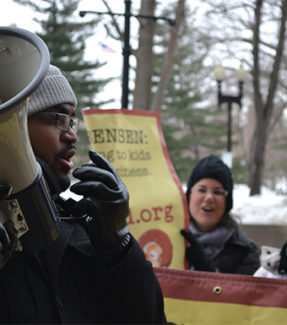
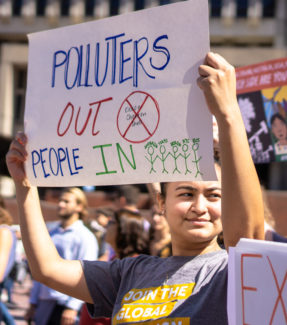
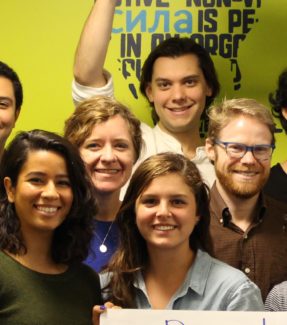
Small groups of people meeting in kitchens and living rooms. Phone trees activated to organize protests in the streets. One-on-one conversations that recruited neighbors to take action, step into their power, and build a collective movement brick by brick. This is how Corporate Accountability’s founding campaign, the Nestlé boycott, was built. And the collective power it generated was what made change happen.
The Nestlé boycott was shaped by the strategists behind the farmworkers’ movement in the 1970s and 1980s. In this, we are one among many other organizations that emerged during this time period. What our founders and early organizers learned from the farmworkers is part of our organizing legacy, part of our DNA of how we organize.
And now we, too, are part of the collective reckoning arising from the allegations of César Chávez’s sexual assaults and the accounts of the culture of permissiveness and silence in the United Farm Workers. Not for the first time, we as a movement are grappling with the harms of an organizing culture that lauds charismatic male leaders and enforces silence and sacrifice for “the cause.” Of course, these harms were never isolated to the United Farm Workers. They have permeated social justice organizing as a whole for far too long.
And inside this truth is another: As long as there have been abusive men at the helm, as long as there has been enforced silence, there have been women, trans, and nonbinary folks resisting and speaking up as they could. This moment is as much about them as it is about the abusers.
So this short post lifts up just a few of the ways that people, particularly Latine women and nonbinary folks, are helping shift the ways we all organize.
No more heros
Uplifiting heroes and relying on them alone to create change is a losing strategy. But understanding that the collective can be the hero—that the collective can create change in a way that no single person can—that is a winning strategy. One that we as a movement have taken too long to acknowledge.
In “The women leading the farmworker movement won’t let it be defined by Cesar Chavez,” the reporters interviewed Latine women who underscore the importance—and erasure—of the collective work done by women inside the movement to make it successful.
Take Illinois Rep. Delia Ramirez: “I don’t believe that there is one hero for our movements. Movements are led by a collective, and you can’t create some pedestal for one person, because humans will always fail you.
Ramirez and other women quoted in the article are clear-eyed about what it takes to create change. In short: collective, collaborative work where everyone’s contribution is necessary and valuable—not just the leaders at the top.
But for so long, we’ve been indoctrinated into the false belief that one person will come save us. Or, as Rebecca Solnit put it in an interview with the New York Times:
“One of the great weaknesses of our era is that we get lone superhero movies that suggest that our big problems are solved by muscly guys in spandex, when actually the world mostly gets changed through collective effort. … A lot of the left wants social change to look like the French Revolution or Che Guevara. Maybe changing the world is more like caregiving than it is like war.”
And indeed, this is what we’ve seen time and again. In Minneapolis this winter, the collective was the hero rising up against ICE. The collective drove ICE out through actions that came from a place of caregiving and collective care, rather than those led by a lone charismatic person. This is one of the lessons of our time.
Accountability always
The reality is that we organize in a world where cisgender men have held too much power and have escaped accountability for their abuses too often.
But we also live in a world where people of all genders—led by women, trans people, and non-binary folks—are shaping a different way to organize and relate to each other and the harmful systems we’re fighting—with values of accountability and dignity for all.
For example, Victoria Valenzuela reports in Waging Nonviolence about a janitorial union in Los Angeles that has created a peer education model to interrupt sexual harassment. It’s grounded in the “promotora,” a culturally specific health care outreach model. “Members are trained to talk to each other, recognize sexual harassment and understand how to intervene in those situations through a restorative lens by interrupting behaviors.”
This “of the people, for the people” model of accountability and intervention trades top-down hierarchy and reliance on “experts” for the wisdom and power of the collective. It’s changing the culture of permissiveness from the ground up.
This is the kind of innovative work that we need in our movements. As Paulina Gonzalez-Brito wrote so beautifully in her first-person account of organizing with the farm workers movement: “Movements may require sacrifice, but the sacrifices liberation asks us to make should be made in the sunlight, not in the darkness of silence. It is these sacrifices that revolutions are made of. If movements are to demand sacrifice, they must also demand self-reflection and accountability.”
Rep. Ramirez reminds us humans will always fail. Yes, that’s part of being human.
And I say, the collective will always surprise us in its power. This, too, is part of being human.
The Nestlé boycott was built on the idea that no force is more powerful than the people, united. We learned this from the farm workers movement. And it is still our bedrock.
All the work we do toward a different kind of world—a more beautiful, just, and liberatory one—we do together: holding each other when we are harmed, working toward accountability and restorative justice, and celebrating our collective successes when we win.
¡El pueblo unido jamás será vencido!