May 20, 2026 — Transnational tobacco corporations continue to exert disproportionate influence over public policy across Latin America and the Caribbean, according to a new report by Corporate Accountability.
The research reveals an alarming pattern of corporate interference extending far beyond ministries of health and into agencies related to security, innovation, and anti-smuggling efforts.
Through agreements with executive branches, diplomatic missions, and customs and law enforcement agencies, the industry seeks to legitimize itself as a “governance partner” while expanding markets for new nicotine products.
The analysis, covering the period 2019–2025 across eight countries in the region (Argentina, Brazil, Colombia, the Dominican Republic, Ecuador, El Salvador, Nicaragua, and Panama), evaluates implementation of Article 5.3 of the WHO Framework Convention on Tobacco Control (WHO FCTC), which legally obliges governments to protect public health policies from the commercial and vested interests of the tobacco industry. Findings point to a systematic erosion of this legal obligation.
During a report launch event, Tom Gatehouse from Tobacco Control Research Group highlighted that, despite industry narratives of transformation, conventional cigarettes continue to overwhelmingly dominate the market in Latin America. He further warned that tobacco companies are attempting to secure control over both traditional cigarette markets and emerging electronic nicotine products. He concluded that the tobacco epidemic is far from over and emphasized the urgent need to continue monitoring, investigating, and exposing industry interference in public health policymaking.
Among the report’s principal findings, the tobacco industry’s most prominent strategies include: co-opting security and law-enforcement agendas; economic pressure and lobbying for novel nicotine products; reputation laundering through “innovation” and corporate social responsibility initiatives; pro-tobacco diplomacy; and conflicts of interest within subnational governments.
Jaime Arcila from Corporate Accountability underscored the essential role played by civil society organizations in implementation of the WHO FCTC, emphasizing their importance in documenting and exposing how major corporations interfere in public institutions. He explained that while States retain sovereign authority to establish policies based on constitutional frameworks and public interest priorities, the tobacco industry—highly concentrated among five major global corporations—continues attempting to shape both traditional and emerging policy environments to prioritize commercial interests over collective wellbeing.
Drawing on analyses conducted in countries including Argentina, the Dominican Republic, Brazil, Colombia, and Panama, he warned that conventional cigarettes remain the primary financial engine sustaining industry profits and enabling broader global corporate strategies. At the same time, he raised concerns regarding growing youth uptake of emerging electronic products, including flagship products promoted by Philip Morris International.
“What we are seeing in Brazil is not an isolated case, but part of a global strategy by the tobacco industry to gain access to political decision-making spaces, including beyond the health sector,” said Mariana Pinho of ACT Promoção da Saúde. “The industry has expanded its presence in legislative, diplomatic, and international arenas, using economic, commercial, and so-called ‘harm reduction’ arguments to influence public policies. This underscores the importance of strengthening transparency mechanisms, ensuring continuous monitoring, and expanding access to information to expose these strategies and fully implement Article 5.3 of the WHO Framework Convention on Tobacco Control across all Brazilian government ministries, thereby protecting public health.”
During his presentation, Erick Antonio Ochoa from Salud Justa Mx stated that while Mexico was not included in the report, the country nevertheless offers a clear illustration of systematic patterns of industry interference. Despite significant policy advances since 2018—including smoke-free environments, advertising restrictions, and a constitutional prohibition on vaping products—the tobacco industry continues influencing public policy through evolving mechanisms.
He highlighted that companies such as Philip Morris and British American Tobacco are increasingly relying on heated and electronic products for global revenue growth. While Mexican policies reduced sales of these products by nearly five percent, the industry appears to compensate by expanding into jurisdictions with weaker regulatory environments, including countries such as Argentina.
He also expressed urgent concern regarding Mexico’s unexpected opening for commercialization of nicotine pouches without adequate consultation with the public health sector, noting that in most countries across the region these products remain largely outside robust regulatory frameworks governing nicotine limits and restrictions comparable to those applied to conventional tobacco products.
Florencia Leiva from Coalition for America’s Health (CLAS) emphasized:
“This report, developed with contributions from actors across the region, reaffirms the critical role of organized civil society. Monitoring and exposing industry interference in public policy is a cornerstone of protecting public health. Today we learned from the experience of tobacco control, but the lessons do not end there. We must continue strengthening and safeguarding public health policies and expand this monitoring to all industries that place commercial interests above the health of our communities.”
To curb corporate interference that undermines the regulatory authority of global health governance, Corporate Accountability urges Latin American governments to:
- Guarantee full transparency by establishing mandatory public registries documenting all interactions between government officials and the tobacco industry.
- Expand institutional safeguards by ensuring that ministries of foreign affairs, finance, security, and trade are systematically included in implementation of Article 5.3 of the WHO FCTC, rather than leaving responsibility solely to health authorities.
- Protect customs and anti-illicit-trade policies by strengthening the Protocol to Eliminate Illicit Trade in Tobacco Products, ensuring that security and tax collection strategies remain 100% free from corporate funding or influence.
The launch event was organized in collaboration with Tobacco Tactics, Vital Strategies, Geneva Global Health Hub, The WHO FCTC Knowledge Hub for Article 5.3 and Salud Justa Mx e ACT Promoção da Saúde.
View the launch here and select the subtitles option for your preferred language.
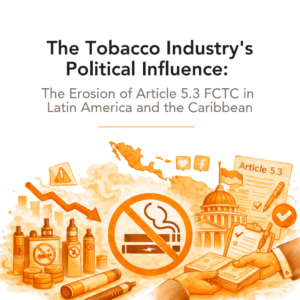
Report: The Tobacco Industry’s Political Influence: The Erosion of Article 5.3 in Latin America and the Caribbean
Contact [email protected] for more information.